The crankshaft is a key component in internal combustion engines, which converts the reciprocating linear motion of the piston into rotational motion, thereby converting the thermal energy generated by the internal combustion engine into mechanical energy. The quality of the crankshaft is related to the overall quality of the engine.
V10 crankshaft diagram
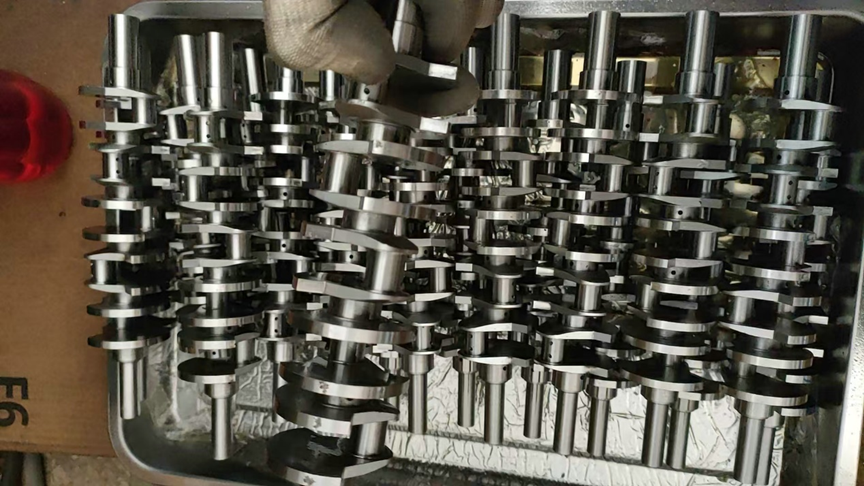
High precision crankshaft machining refers to the precise size, shape, and position machining of the crankshaft to meet the high performance and reliability requirements of the engine. The crankshaft is a key component in internal combustion engines, which converts the reciprocating motion of the piston into rotational motion. Therefore, its machining accuracy directly affects the efficiency and lifespan of the engine.
The following are some key steps and techniques for high-precision crankshaft machining:
1. Material selection: Choose suitable materials, such as alloy steel, which has good strength, hardness, and wear resistance.
2. Preparation of raw materials: According to the design drawings, the raw materials are processed into raw materials, usually including rough machining and precision machining.
3. Rough machining: Use CNC lathes, CNC grinders and other equipment for rough machining, remove most of the material, and form a preliminary crankshaft shape.
4. Semi precision machining: Semi precision machining of the crankshaft, including precision turning, precision grinding, etc., to approximate the final size and shape.
5. Heat treatment: Heat treatment is carried out on the crankshaft, such as quenching and tempering, aging, etc., to improve its hardness and wear resistance.
6. Precision machining: high-precision grinding machines, grinding centers, etc. are used for precision machining to ensure the dimensional and shape accuracy of the crankshaft.
7. Surface treatment: Polish or coat the surface of the crankshaft to improve its surface smoothness and wear resistance.
8. Measurement and inspection: Use high-precision measuring equipment, such as coordinate measuring machines (CMM), to measure and inspect the size and shape of the crankshaft.
In order to produce a good engine, we use the machining process of a real engine to process the crankshaft of the model engine. Firstly, all of our crankshafts are rough machined using a high-precision four axis machining center. After rough machining is completed, the size and quality of the rough material are checked. After the quality meets the requirements, the crankshaft is semi precision machined using a CNC lathe. Then, the rough material is heat treated to ensure its deformation and quenching hardness. After heat treatment is completed, the crankshaft is precision machined using a CNC follow-up grinder to perform external cylindrical grinding on each shaft of the crankshaft. After reaching the standard size, the crankshaft is basically machined. Finally, before installing the engine, the surface and size of the crankshaft are measured and processed.